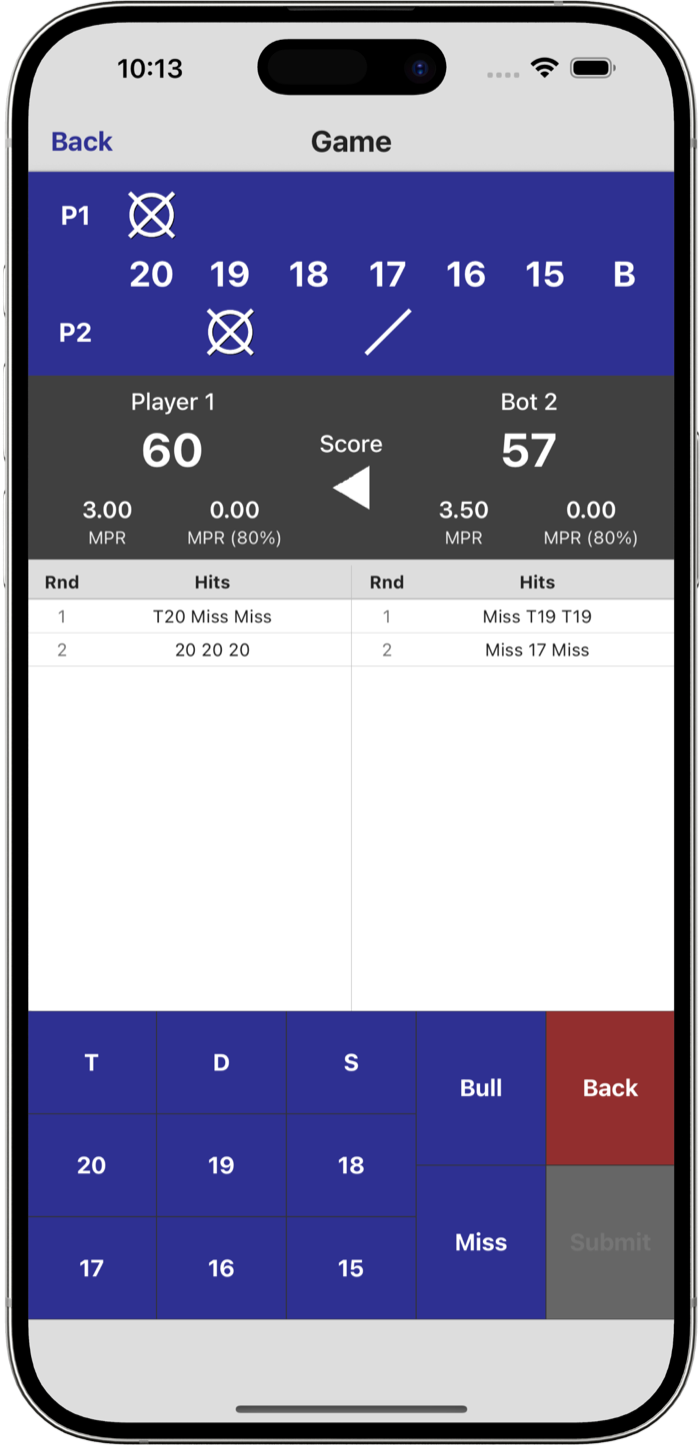
Score when you are behind on points
If your opponent leads and has open numbers, pile points onto your highest open numbers before they close them. You need to close the gap before closing out all targets.
Cricket darts strategy guide
Cricket darts rewards both accuracy and decision-making. Knowing when to score and when to close — and practising those decisions under pressure — is what separates consistent winners from players who rely on luck.
Number order
The most effective opening in Cricket darts is to close 20 first. A triple 20 scores 60 points per mark hit after closing — the highest scoring rate of any target. If you open 20 before your opponent and they have not closed it, you can build a large point lead quickly.
Work down from 20 to 15 in order. The bullseye is left for last because it is the hardest target on the board to hit consistently. Scoring off a closed bull is difficult, so the strategic value of closing it early is low compared to the time and darts you spend trying.
The core decision
The central strategic tension in Cricket darts is choosing between scoring more points on a number you own or closing a number your opponent owns to stop them scoring.
If your opponent leads and has open numbers, pile points onto your highest open numbers before they close them. You need to close the gap before closing out all targets.
If you are ahead, closing your opponent's open numbers stops them scoring further. Work towards closing everything out while protecting your lead.
When scores are even, close the highest numbered targets first. This removes your opponent's best scoring opportunities and gives you the initiative.
Rule variation
Overkill is a rule variation where points scored on an open number can run the opponent into a points deficit — meaning they have to score back past zero to win. When overkill is in play, aggressive scoring becomes a direct weapon rather than just a lead-building tool.
Under overkill rules, closing your opponent's numbers becomes even more urgent. Leave a high-value number open against a strong scorer and they can put you in a position where you need to outscore a large deficit with your remaining targets.
Cricket Trainer supports overkill as an optional game setting. Practising under overkill rules trains more aggressive, decisive play — which carries over to standard games as well.
Going first
Going first in Cricket darts is a meaningful advantage. The player who throws first has the opportunity to open 20 and start scoring before their opponent has the chance to close it. Over time this compounds — first-mover players typically reach a scoring lead before the trailing player can respond.
In casual games, a coin toss or bull-off (each player throws one dart; closest to bull goes first) determines who starts. In competitive play, a bull-off is standard.
When practising solo, Cricket Trainer alternates who goes first by default, which mirrors fair competitive conditions.
Practice strategy
Strategy knowledge is only useful if your accuracy can execute it. The most effective way to improve is regular solo practice reps — making decisions and then seeing whether your darts actually go where you need them.
Set the AI opponent one or two difficulty levels below your current standard. This gives you room to try strategic decisions without the pressure of falling behind immediately.
Track your marks per round after each session. A rising MPR tells you your accuracy is improving. Aim to raise your average by 0.2 marks at a time rather than chasing big jumps.
Use lower difficulty to practise scoring aggressively. Use higher difficulty to practice closing under pressure. Varying the opponent style — passive, aggressive, random — trains different decision patterns.
Try these strategies
No opponent needed. Cricket Trainer gives you 30 AI difficulty levels and 30 playing styles to practice every strategic situation — solo, any time.